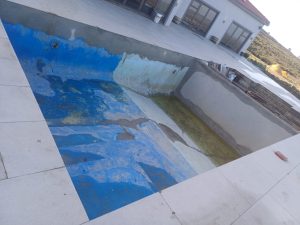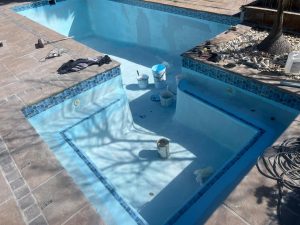
It is the most confusing sight in pool care: the test kit swears chlorine is high, and the water is still green. Owners respond by adding MORE chlorine — sometimes for weeks — and the pool shrugs it off. The explanation is always one of five things, and none of them is “add more chlorine.” Here they are, in the order we actually find them on Cape Town call-outs.
1. Stabiliser lock-up (the big one)

Years of stabilised chlorine granules and floater pucks quietly push cyanuric acid (CYA) past 100+ ppm — and at those levels your chlorine is present but handcuffed, reacting too slowly to kill a bloom. The test reads high; the algae doesn’t care. Diagnosis is a CYA test; the fix is partial dilution and a dosing change — the full story is in our stabiliser guide. If your pool has been dosed from the same bucket brand for years, start here.
2. It is not algae — it is metals
A pool that turned green-tinged immediately after shocking, with clear (not cloudy) water, is usually oxidised copper or iron, not algae — classic after borehole top-ups or copper algaecide history. Chlorine cannot kill a metal; it is what revealed it. The fix is sequestrant chemistry and managing the fill water, not more shock. Tell-tale: green CLEAR water = metals; green CLOUDY water = algae.
60-second diagnosis:
- Green + clear water, straight after shocking → metals
- Green + cloudy, chlorine high for days → CYA lock-up or filtration
- Green film on walls that brushes off and returns → surface/rooted algae
- Green after every storm despite dosing → phosphate load
3. Filtration theatre
A channelled sand bed or worn pump moves water without cleaning it — dead and living algae just recirculate. The giveaway: filter pressure that rebounds within days of backwashing, or a pool that never polishes even when blue. High chlorine plus broken filtration equals a permanently tired pool; the fix lives in the plant room, on the standard menu of our pump and filtration repairs.
4. Phosphate banquet
Storm runoff, lawn fertiliser and leaf decay load water with phosphates — algae food. A heavily fed bloom can grow nearly as fast as marginal chlorine kills it, producing the exact “high chlorine, still green” stalemate. After our winter storms this is common; a phosphate test and remover break the stalemate, and our storm-greening guide covers prevention.
5. Algae with a fortress
On rough, porous, aged surfaces — older marbelite especially — algae roots below the surface where chlorine barely reaches. You kill the visible layer; the roots regrow it within days. If your pool re-greens from the same patches every time, the chemistry was never the problem: the surface is finished, and honest money goes to resurfacing, not another decade of chemical warfare. (Our published case studies show exactly what that rescue looks like.)
Stop guessing — test in this order
- CYA (stabiliser) — if 100+, you have your answer;
- Water clarity check — clear-green means metals;
- Filter pressure behaviour across a week — rebound means filtration;
- Phosphates — especially after storms;
- Surface inspection — rough and patch-loyal algae means the shell.
Or skip the kit shopping: our free pool assessment runs the whole sequence in one visit and gives you the actual cause in writing — with the fix priced honestly, whether it is a R200 chemical or a filtration repair.
Frequently asked questions
Can a chlorine test read falsely high?
Very high chlorine can bleach test reagents into misleading readings — another reason strip-and-guess dosing fails. Proper drop tests or professional testing settle it.
How much shock does a genuinely green pool need?
Multiples of a normal dose, scaled to volume and severity — underdosing repeatedly is both slower and more expensive than one properly sized shock.
Should I drain a pool that stays green?
Only for confirmed CYA lock-up, and then partially — and only after ruling out the other four causes. Draining an older shell casually is how surface problems become structural ones.
My pool guy says keep adding chlorine. Is he wrong?
If it has been three weeks of that, yes — something upstream is broken, and the five causes above are where the answer lives.
If the pool stays green no matter what you dose, our pool cleaning team in Cape Town can test, correct and if needed reline a surface that keeps feeding algae.