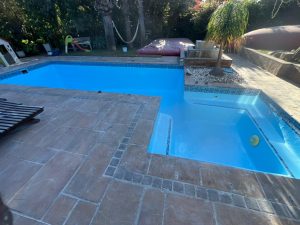
Cape Town gardens are shrinking — new builds trade lawn for living space — but the pool dream has not shrunk with them. Good news: some of the best pools we service live on tiny erven. Choosing how to fit a pool into a small garden is mostly about shape and placement discipline, and the decisions differ from what big-garden logic suggests.
How to choose a pool shape: start with use, not looks
Match shape to real use:
- Kids splashing: compact rectangle or square — maximum shallow area, easy to net
- Exercise: narrow rectangle — 6m+ of straight swimming beats any curve
- Cooling off & entertaining: plunge pool or square — depth over distance
- Garden showpiece: geometric shapes frame small spaces better than free-form curves
Why rectangles win small gardens
Free-form curves flatter big landscapes; in small spaces they waste swimming area, complicate paving cuts and fight the boundary lines. A rectangle set parallel to the boundary maximises water per square metre, takes safety nets and covers cleanly (curved pools make every cover a custom template — and cost it), and paves economically. Nearly every small-garden brief we see ends best as a crisp rectangle or square — the exceptions are corner-plot triangles where a custom gunite shape genuinely earns its keep.
The small-garden placement rules Cape Town adds
- Respect the wind line: site the pool in the lee of the house or a solid wall — a small pool in the full south-easter loses water and heat relentlessly, and collects the garden’s debris;
- Chase winter sun: small pools shade easily; a spot open to the north keeps the season longer for free;
- Leave the service margin: at least a paved walkway on all sides — the pools we struggle to repair are the ones built hard against boundary walls;
- Plan the pump home now: equipment needs a ventilated, accessible corner — retrofitting one into a finished small garden is misery.
Plunge pools: the honest small-garden hero
The plunge pool — compact, often deeper, built for cooling rather than laps — suits small Cape Town gardens brilliantly: less water to treat and heat, smaller equipment, quicker covers, and a designed-object look that lifts the whole garden. Running costs scale down with volume, which makes plunge pools the cheapest real pools to own well. They also renovate beautifully: several of our relining projects turned oversized old pools into refreshed smaller-feeling spaces with new linings and rebuilt surrounds.
Already got an awkward-shaped pool?
Renovation can re-shape reality more than owners expect: steps re-formed, depths altered, even footprints reduced during major work — and the surrounds redone so the pool finally fits its garden (our renovations service covers exactly this). The free assessment is the place to ask “what could this pool become?” — the answer is usually more flexible than assumed. New build from scratch? Start at pool installations Cape Town.
Frequently asked questions
What is the smallest worthwhile pool?
Genuinely usable plunge pools start around 3m x 2.5m — below that you are building a spa, which is its own fine answer.
Do small pools cost proportionally less to run?
Better than proportionally — smaller volume means smaller pump, less chemical, quicker cover, shorter run hours. Small pools are efficient pools.
Rectangle or square for a courtyard?
Square reads architectural and suits courtyards; rectangle wins if anyone will actually swim strokes. Decide on the swimming question honestly.
Can you put a pool in a garden with crane-only access?
Yes — craned fibreglass shells or hand-dug gunite both solve tight access; it affects method and price, not possibility. Site assessment answers it exactly.