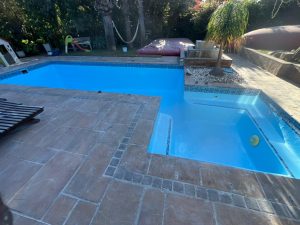
The fibreglass vs concrete pools debate is the first fork in every new-pool journey, and both camps oversell. Having repaired, relined and restored thousands of both across Cape Town — we know exactly how each type ages here — this is the comparison written from the maintenance end of the telescope, which is where you will live with the decision.
Fibreglass vs concrete pools in one view:
- Fibreglass shell: faster install, lower entry cost, smooth low-chemical surface; sizes/shapes limited to moulds
- Concrete/gunite: any shape, any size, generational lifespan; costs more, takes months, surface needs renewal every 10–20 years
- Both: end up needing the same supporting cast — filtration, surrounds, covers — sized properly
Where fibreglass pools win
- Speed: a moulded shell installs in weeks, not months — excavation to swimming inside a school holiday;
- Surface economics: the gelcoat finish is smooth, algae-resistant and gentle on chemicals for years;
- Cost of entry: for standard family sizes, fibreglass usually undercuts equivalent concrete builds meaningfully;
- Coastal temperament: the surface handles our salt air and chemistry corrections gracefully — a real West Coast advantage.
Where concrete pools win
- Total freedom: any shape, depth, size — infinity edges, tanning ledges, the pool that fits THIS terrace exactly;
- The fifty-year shell: Cape Town’s suburbs are full of 1970s gunite pools still structurally excellent — over-engineered concrete simply lasts (our gunite guide tells that story);
- Renewability: surfaces refresh — marbelite today, fibreglass lining in twenty years — while the shell soldiers on;
- Difficult sites: slopes, tight access, unusual ground: concrete adapts where moulds cannot.
The ageing story nobody tells you upfront
Both types converge on the same truth at year 15–20: the surface needs renewal. Concrete pools resurface (marbelite) or convert to fibreglass lining; fibreglass shells reline when their gelcoat finally goes. We publish exactly what that costs — R54 000 – R60 000 for our documented 8m x 4m fibreglass reline — because surface renewal is part of the total-ownership maths brochures skip. Neither choice avoids it; both survive it well.
The Cape Town decision framework
- Standard rectangle, standard garden, budget-aware: fibreglass, comfortably;
- Custom vision, tricky site, forever-home: concrete earns its premium;
- Buying a house with an old concrete pool? Restore it — a sound shell restored costs a fraction of any new build (our relining projects show it);
- Either way: the installer’s process discipline matters more than the material — per our quotation standard, itemised in writing or walk away.
Weighing a new pool or a restoration? Our installations page covers both paths, and the site assessment is free — including the honest “restore what you have” conversation most installers will not open.
Frequently asked questions
Which is cheaper long-term, fibreglass or concrete?
Over 25 years they land closer than the entry prices suggest — concrete costs more upfront and at resurfacing; fibreglass costs less at both but relines too eventually. Choose on fit, not on a spreadsheet myth.
Do fibreglass pools pop out of the ground?
Only when installed badly or drained carelessly over high groundwater — proper installation and never-casual draining prevent the horror stories.
Can a concrete pool be made as smooth as fibreglass?
A fibreglass LINING over concrete delivers exactly that — the popular conversion in our diary combining concrete’s shell with fibreglass’s skin.
Which handles Cape Town wind and salt better?
Surfaces: fibreglass, slightly. Structures: both shrug it off. Equipment corrodes identically either way — position and cover it well.